Frequently Asked Questions
General Questions About Freedom Defense Services
Freedom Defense Services is based in Corona and serves clients across Southern California. We regularly work in Los Angeles County, Orange County, San Diego, and the Inland Empire, and can support multi-site clients in other parts of California when needed.
We provide a full security guard program that includes Armed Security Guards, Unarmed Security Guards, Mobile Patrol Security Services, and Commercial and Industrial Security Guards. These services support offices, industrial facilities, retail centers, residential communities, healthcare sites, schools, and special events. We also offer a Consulting and Investigations Division for planning, incident review, and risk work.
Yes. Freedom Defense Services operates as a licensed Private Patrol Operator in the State of California. All security officers hold valid BSIS Guard Cards and, for armed roles, BSIS firearm permits. We carry general liability, workers’ compensation, and commercial auto coverage that meets or exceeds typical contract requirements.
Questions About Guards, Hiring, And Training
We start with a structured hiring and screening program. Candidates go through background checks, license verification, interviews, and reference checks. From there, we match guards to your property type, so an officer who fits an industrial yard is not placed blindly into a residential lobby.
Every officer completes state-required BSIS training plus our internal curriculum. Topics include California law for private security, patrol and observation, report writing, de-escalation, emergency response, and customer contact. Each officer also receives site-specific training at your property so they know your layout, rules, and expectations before working alone.
For many accounts, especially higher-risk or high-visibility sites, clients can be involved in final selection. We can provide guard profiles, arrange interviews, or set meet-and-greet visits ahead of assignment. These preferences become part of your program management plan.
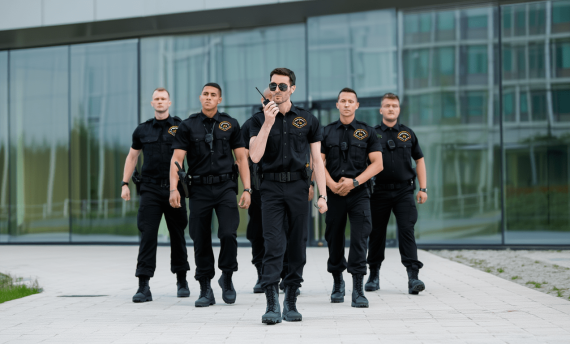
Yes. Officers wear uniforms with clear company identification and name badges. For some properties we use a softer look that fits a corporate or hospitality setting; for others, a more traditional appearance suited to industrial and outdoor work. Identification and licensing are always available for inspection.
Questions About Armed, Unarmed, And Mobile Patrol
The decision comes down to risk, not just preference. We review your incident history, the value and nature of what you protect, neighborhood crime patterns, and insurance requirements. Many properties start with unarmed guards and add armed officers at select posts or during higher-risk hours if needed.
Fixed guards stay at one post, such as a lobby, gate, or reception desk. Mobile Patrol Security uses marked vehicles to cover larger areas, multiple buildings, or several nearby properties. Patrol officers drive and walk routes, check doors and gates, and respond to alarms. Many clients use both: fixed officers for steady coverage and mobile patrol for broad sweeps and after-hours checks.
Yes, if the sites are close enough and the risk level supports shared coverage. We often design routes where one vehicle patrols several retail pads, small offices, or HOA communities in the same area. For larger warehouses or complex campuses, a patrol unit may focus on a single property.

Questions About Industries And Property Types
We serve a wide range of locations including office buildings, corporate campuses, industrial and warehouse sites, logistics hubs, retail centers, shopping malls, mixed-use properties, residential and HOA communities, healthcare facilities, schools, and special events. Each sector has different needs, so we write post orders that fit your environment.
Yes. Many of our clients operate warehouses, manufacturing plants, truck yards, and distribution centers in the Inland Empire and other industrial markets. We handle gates, yards, docks, and high-value inventory in those settings.
We work with apartment communities, gated neighborhoods, and master-planned developments across several Southern California counties. Services can include gate officers, roving vehicle patrol, amenity checks, parking control, and support for house rules.
Questions About Pricing And Contracts
Rates vary based on post type, hours, location, and risk level. Armed officers cost more than unarmed guards. Mobile patrol is priced differently than a fixed post. California unarmed rates are generally higher than in many other states due to wage, license, and insurance costs. The best way to get accurate pricing is to request a quote with details about your property, schedule, and risk concerns.
Some schedules, such as overnight shifts or certain holidays, carry different rates due to staffing and labor rules. We explain these details clearly in our proposals. If you are flexible on hours or staffing levels, we can discuss ways to keep your budget in line while still keeping your property protected.
There is usually a minimum for ongoing contracts, and a smaller minimum for short-term or event work. A 24/7 post is structured differently from a part-time lobby guard or a few weekly mobile patrol visits. We explain these thresholds during the proposal so you can decide what level of coverage makes sense.
Yes. We can provide temporary coverage for projects, construction, special events, or short-notice needs such as fire watch and emergency conditions.

Questions About Daily Operations And Reporting
Guards complete daily activity reports and incident reports for your property. Depending on your setup, these may be written, digital, or part of a guard tour system. Program management reviews report quality and can also arrange summary emails or regular review meetings.
Site leads, field supervisors, and operations managers all play a part. Supervisors conduct visits, check uniforms and performance, review reports, and respond to client feedback. We want you to know that someone is responsible for performance beyond the officer at your front door.
Yes. Guards are trained to support your emergency plans and to work with building management during fire alarms, evacuations, medical calls, and other incidents. Our Consulting and Investigations Division can also review your procedures and align guard training with the results.
Security officers are not police. Their role is to observe, deter, report, and respond within private security limits. When a crime is in progress or a serious threat appears, guards contact local law enforcement and provide clear information. Over time, many sites see patrol officers or deputies become familiar with the property and the guards, which helps response and coordination.


Questions About Starting Or Changing A Program
Yes. Many clients bring Freedom Defense Services in for a second opinion before they change vendors. Our consultants can review your current staffing, post orders, incident history, and equipment. This work can be done even if you decide to stay with your current provider.
Start-up normally includes a site visit, review of your current program, and a planning session. We then create post orders, select guards, schedule training, and set a start date. For multi-site accounts, we may phase in locations so that change is controlled and your operations are not disrupted.
Timing depends on how many posts you need, the level of risk, and whether armed officers are involved. Some small unarmed programs can start quickly. Larger, complex, or high-risk programs need more time for hiring, training, and coordination. We will give you realistic time frames during the proposal stage.
Yes. Involving security planning early in a project often saves money and prevents gaps later. Our Consulting and Investigations Division can work with your design, facilities, and operations teams to plan access control, camera coverage, guard posts, and patrol paths before the site opens.